
Theology Central
Theology Central exists as a place of conversation and information for faculty and friends of Central Baptist Theological Seminary. Posts include seminary news, information, and opinion pieces about ministry, theology, and scholarship.The Ultimate Seasoning
I used to joke that I grew up in a culture that used grease as a seasoning. Come to find out, it’s a thing. Here are “28 Delicious Ways to Use Leftover Bacon Fat.”
Nigerian Bishop Raps US for Ideological Colonization
Ironic, isn’t it? Liberals have taught us a sense of horror and cultural imperialism and ideological colonization. Yet according to Bishop Emmanuel Badejo, that is exactly what US liberals are doing to Africa. He complains that the USA refuses to help Nigeria in its fight against terrorist Muslim group Boko Haram until the Africans modify their position on homosexuality and birth control. You can read the story here.
Remembering Bruce Charpie
Yesterday (Thursday, November 17), was Bruce Charpie’s funeral. He passed away a few days ago after a brief bout with leukemia. The funeral was one of the most Christ honoring that I can remember attending. It was genuinely a model of how believers ought to mark the death of a fellow saint.
I’ve known Bruce and his wife, Pennie, for decades. We used to go to the same church and attend the same school, Bruce as an undergrad and I as a seminary student. I may even have had him in a few classes when I started teaching. I know that Pennie was in some of my classes. That was back during the early-to-mid 80s.
Bruce went into church planting in Ohio and Arizona. I left to pastor a church in Iowa, then plant another in Texas, all while pursing doctoral studies. Twenty years or more passed during which we had little contact with each other. Then Bruce moved to Minnesota to work on his MDiv at Central Baptist Theological Seminary, where I was a professor.
In Minnesota, Bruce became very active at Fourth Baptist Church. He served as a teacher and a deacon. At one point when I was president he actually sat on the board of Central Seminary. He eventually left Fourth Baptist to help in a daughter church, Family Baptist Church. He was still serving faithfully there at the time of his death.
While in Minnesota Bruce also served in interim pastorates and helped as pulpit supply. The Lord never led him back into a pastorate, but that didn’t make Bruce any less a man of God. He reared three children of whom any father could be proud, and he left seven grandchildren behind him.
I am thankful for the life and example of Bruce Charpie. His funeral was a rehearsal of the grace of God in his life. We heard his children blessing his memory and his pastor thanking God for his leadership. We heard of his trust in Christ; we also heard of the Christ whom he trusted. His son David in particular offered a genuinely thoughtful and ordinate reflection upon his father’s life of faith.
Most of the world never heard of Bruce. He served joyfully in obscurity. I don’t know whether he saw himself as a success or not. I do know that God used him to touch and shape lives, and God is continuing to do so. Even in his homegoing he has set an example to which we ought to aspire.
Two by John Owen
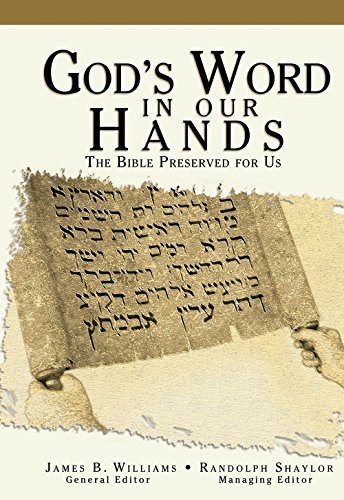
“God’s Word in Our Hands” for Kindle
Only 99 cents at Amazon. This book is a treatment of biblical preservation. It was written and published by fundamentalists.
Chaplain Jeff Freeman
Fourth Baptist Church regularly features missionary speakers on Wednesday evenings. Last night we heard Jeff Freeman, a recent graduate of Central Seminary. Jeff isn’t a missionary in the usual sense. He is chaplain at the Hennepin County Correctional Facility–called the Work House by those who live there. He spent most of an hour telling us what it is like to minister to prisoners and staff in a correctional institution.
As we listened, I found myself thinking that Jeff is doing exactly what we want our graduates to do. He is taking to gospel to people who need it, leading them to faith in Christ, and then discipling them toward a level of maturity. And he is doing it effectively.
Jeff was always one of the quiet students in class, but he is not shy in front of an audience. He spoke with clarity and conviction, using his dry sense of humor to carry us with him through the description of a ministry that can be grim at times. And Jeff is certainly bold in the work that God has given him.
The Work House is only a few miles from the campus of Central Baptist Theological Seminary. Jeff is suggesting an internship for seminary students who want to learn to minister in correctional institutions. I think it’s a great idea. A pastor or missionary ought to know the techniques and procedures for ministering in jails and prisons. Whether we ever offer this as a formal internship, Central Seminary has a graduate who would love to mentor any seminary student in what we used to call “jail ministry.”
Berkhof’s Systematic Theology for Kindle
And it’s only $1.99 at Amazon. Berkhof’s theology is a standard tool for those wishing to understand the Presbyterian and Reformed system of faith.
![Systematic Theology by [Berkhof, Louis]](https://images-na.ssl-images-amazon.com/images/I/518S3bdBfNL.jpg)
Cliff Barrows with the Lord
Cliff Barrows died on Tuesday. He was the song leader for the Billy Graham evangelistic team. But he was much more.
I don’t know how I’d ever document this, but I’m convinced that Barrows became the model for two generations of fundamentalist and evangelical song leaders. In doing so, he transformed the gospel song tradition that he had received.
The idea first occurred to me years ago as the result of a conversation with a retired music professor in a Christian college. This man had trained at least two generations of fundamentalist song leaders. As he reminisced about his influence, he commented that he had modeled his song leading “after the style of Cliff Barrows.” I asked what that meant, and he went on to name some of the elements that Barrows had introduced.
Song leading occupies a narrow place in evangelical history. Traditional churches did not have song leaders–the congregation followed the organ. Folk churches tended to sing by call and response. Contemporary churches don’t have song leaders at all. Song leading appears to have been widely practiced mainly in American evangelicalism (including fundamentalism) from some point after the Second Great Awakening down through the 1970s. It began to die out in the 1980s and is almost gone now.
Barrows teamed up with Graham in 1947. Effectively, the team brought the electricity of the youth rally into the evangelistic campaign. Barrows’ approach to the song service was pivotal to the success of that maneuver. He mastered the technique of drawing people into the song service, of getting people who usually didn’t sing at all to lift their voices with abandon. If song leading is an art, Barrows probably represented its apex.
What Is A “Convergent?”
The Fundamental Baptist Fellowship International recently coined the word “convergent” to describe people who occupy a position that it sees as a particular threat to biblical fundamentalism. What is a convergent? I think I know the answer to that question, but the FBFI has not exactly provided a crystalline definition–as Tyler Robbins pointed out. Now Don Johnson, the editor of Proclaim and Defend (the blog of the FBFI) has written an explanatory piece and published it on his own private blog, an oxgoad, eh? The problem is that Pastor Johnson’s explanation doesn’t really do much to explain. Here is his list of characteristics.
-
Anti-separatism (or at least non-separatism)
-
Embrace of a philosophy of fellowship, social action, cultural relevancy that is at least similar to new evangelicalism
-
Movement from fundamentalist to the convergence philosophy – i.e. the philosophy that embraces evangelicalism and its positions as opposed to fundamentalism and its positions
-
“First-love” Calvinism – the love of a zealot for the new found perfect theology (as opposed to the Calvinist fundamentalist who willingly co-labors with non-Calvinists who share a fundamentalist philosophy)
-
A new emphasis on Christian liberty (often expressed in use of alcohol and a broader taste in Christian music)
-
Pragmatism in church polity (Application of modern business models to church governance and business practices)
-
In some, questionable pastoral ethics, seen in shifting existing congregations away from fundamentalist roots
-
An openness or even embrace of supernatural gifts, especially prophecy, as legitimate modern phenomena
-
A keen interest in the “star” evangelical writers as the “go-to” guys for ministry philosophy, doctrine, reading, etc. And perhaps not only interest, but promotion of their writings as the last word on the subjects they address.
Because I know the boys in the FBFI (I am a member), I think I know what they mean when they talk about “convergents.” If I didn’t already have a good idea, though, I don’t believe that either the organization or Pastor Johnson would give me much help in figuring it out. And I honestly have no idea who might actually fit all of the items on Pastor Johnson’s list. I’m generally sympathetic to the concerns of the FBFI, or I wouldn’t retain membership. I Still, I wish they’d do a better job of explaining themselves.
A Worship Catechism
David De Bruyn has been publishing “A Worship Catechism” at Churches Without Chests. It is well worth a look. I’ve linked to the first installment, but there are several.
1. What is the great priority and purpose of man?
Man’s great priority and purpose is to love God with his entire being: heart, soul, mind and strength (Mk 12:29-30).
2. Why is this man’s great priority and purpose?
Loving with the entire being is worship: expressing the worth and value due to God (Ps 29:1-2). Man was created to express this glory (Is 43:3), as image-bearers (Gen 1:26-27), just as the entire created order is to reflect and magnify the worth of God (Psa 150, Rev 4:11).
3. Why should all creatures magnify God’s worth?
God is Beauty (Job 40:9-10). The Triune God is the perfection of all excellence in Being, the most delightful conjunction of all attributes of Deity, the quintessence of truth and goodness, and the most admirable and sweetest expression of this loveliness. This glory calls for the appropriate response of highest enjoyment and admiration (Psa 113:3).
4. Why should God delight in this worship?
God delights in His own glory above all things, knowing that the magnification of His glory is the greater good of all (Joh 17:24-26)
To Mock Or Not To Mock
Jordan Standridge is concerned about political idolatry in the church. Pastor Standridge sees evidence of this idolatry in the attitudes of some evangelicals as they comment on political matters. Here is the core of his argument:
And the mocking has begun. My Facebook is filled with comments about snowflakes, hypocrites and lefties who supposedly are so evil and so despicable that they need to be ridiculed for their tears. The problem is that these snowflakes we’re mocking are my mission field. I talk to so many of them on a weekly basis. Despite Scripture’s warnings about letting no unwholesome words out of our mouths, and only using words that are able to build others up (Eph. 4:29), we think that because some wanted to push abortion and gay marriage that we’re allowed to speak of them any way we choose.
I think that Pastor Standridge is trying very hard to make a moral issue out of a prudential one. He has not established that all mockery is incompatible with either loving or witnessing to the lost. In fact, the Bible certainly seems to indicate that some mockery is essential to biblical witness. Elijah mocked the prophets of Baal. Isaiah dished out scorn to idolaters. Jesus excoriated the Jewish leadership of his day, and He didn’t even spare His own disciples (“Get thou behind me, Satan”).
Pastor Standridge prays that, “we repent and start treating them as Paul would, like people who will spend eternity in heaven or hell.” He appears not to remember that Paul was not above a bit of castigat ridendo mores, especially in the Corinthian epistles. Here is an example from 2 Corinthians 11:
Since many boast according to the flesh, I will boast also. For you, being so wise, tolerate the foolish gladly. For you tolerate it if anyone enslaves you, anyone devours you, anyone takes advantage of you, anyone exalts himself, anyone hits you in the face. To my shame I must say that we have been weak by comparison.
To be sure, not all uses of mockery are good uses. Mockery can be a form of abuse, and when it is, it is evil. But not all mockery is either abusive or evil. Sometimes it is precisely the tool that is necessary to show people who they really are.
The trouble is that mockery is difficult to do well. It may repel people unnecessarily (there is such a thing as necessary repulsion). Furthermore, when we mock, we can easily permit the fleshly attitudes to assert themselves. We can give way to pride, bitterness, and vengeance. Nevertheless, it is just as possible that a refusal to engage in sharp discourse–including mockery–can also betray fleshly attitudes such as cowardice, concessiveness, or a desire to be thought well of by worldly people.
Some tears need to be ridiculed. So does some laughter. And some indifference. A blanket denunciation of ridicule does not serve the interests of truth.
Church History: Two Reference Tools for Cheap (Kindle)
You should own (and read) both of these.
The New England Soul by Harry Stout. $2.99

Church History in Plain Language by Bruce Shelley. $3.99
![Church History in Plain Language: Fourth Edition by [Shelley, Dr. Bruce L.]](https://images-na.ssl-images-amazon.com/images/I/51A4L2hhaIL.jpg)
Best Books List for Boys
The Art of Manliness lists the “50 Best Books for Boys and Young Men.” Some I’ve read, some I’ve haven’t. I’ll have to work my way through the list.
The Doctrine of Providence
Kevin DeYoung has an excellent discussion of the doctrine of God’s Providence.
You can look at providence through the lens of human autonomy and our idolatrous notions of freedom and see a mean God moving tsunamis and kings like chess pieces in some kind of perverse divine play-time. Or you can look at providence through the lens of Scripture and see a loving God counting the hairs on our heads and directing the sparrows in the sky so that we might live life unafraid.
Westminster Seminary Founding Faculty
Justin Taylor displays a newly colorized photo and explains how and by whom the work was done. For historians and Machen fans, this picture is just about priceless. Among other things, it includes a young Alan MacRae, who would side with McIntire against Machen, become one of the founders of Faith Theological Seminary, and then break with Machen to found Biblical Theological Seminary. MacRae is a largely forgotten figure and a bit of a paradox. He insisted until his death that he was a faithful covenant theologian, but served as one of the editors for the New Scofield Reference Bible. MacRae was also active in the American Council of Christian Churches–he was a genuine fundamentalist in the best sense of the term.
It’s also interesting to me that Machen is wearing boots instead of dress shoes in this photograph. They’re well worn, indicating that this was probably his standard footwear. But then, Machen was a mountaineer. Maybe that has something to do with it.
The photos also includes the Ned Stonehouse, Paul Wooley, and Cornelius Van Til–all very young men at the time. It does not include Carl McIntire, who was still a student. Van Til once remarked, however, that there would have been no Westminster Theological Seminary had it not been for Carl McIntire.
Time To Limit Executive Power?
Trevor Burrus says yes. For his putative conservatism, George W. Bush amassed significant power for the executive branch. Barack Obama has arrogated even more. Religious freedom depends, in part, upon the ability of the congress and the courts to restrain that kind of power. Here’s Burrus:
Here’s a basic principle of good government: Don’t endorse a government power that you wouldn’t want wielded by your worst political enemy. Democrats will soon be learning that painful lesson.
Ideally, the appointment of originalist judges will work against an unrestrained executive branch.
What President Trump Can Do About Religious Freedom
Ryan Anderson offers a cogent set of recommendations in “Make Religious Freedom Great Again.”
Whether it be harassing an order of nuns, forcing doctors to perform sex-reassignment therapies, or preventing local schools from finding win-win compromise solutions that would respect all students’ bodily privacy, the Obama administration has waged an aggressive and unnecessary culture war. Because it has done so almost exclusively through executive action, a Trump administration can quickly undo this damage. And Congress can then ratify it permanently in law. That’ll go a long way toward protecting peaceful coexistence, making American truly great again.
“Charitas Nimia” by Richard Crashaw
Charitas Nimia; Or, The Dear Bargain
Richard Crashaw
Lord, what is man? why should he cost Thee
So dear? what had his ruin lost Thee?
Lord, what is man, that Thou hast over-bought
So much a thing of naught?
Love is too kind, I see, and can
Make but a simple merchant-man.
‘Twas for such sorry merchandise
Bold painters have put out his eyes.
Alas, sweet Lord! what were’t to Thee
If there were no such worms as we?
Heav’n ne’er the less still Heav’n would be,
Should mankind dwell
In the deep hell.
What have his woes to do with Thee?
Let him go weep
O’er his own wounds;
Seraphims will not sleep,
Nor spheres let fall their faithful rounds.
Still would the youthful spirits sing,
And still Thy spacious palace ring;
Still would those beauteous ministers of light
Burn all as bright,
And bow their flaming heads before Thee;
Still thrones and dominations would adore Thee.
Still would those ever-wakeful sons of fire
Keep warm Thy praise
Both nights and days,
And teach Thy loved name to their noble lyre.
Let froward dust then do its kind,
And give itself for sport to the proud wind.
Why should a piece of peevish clay plead shares
In the eternity of Thy old cares?
Why shouldst Thou bow Thy awful breast to see
What mine own madnesses have done with me?
Should not the king still keep his throne
Because some desperate fool’s undone?
Or will the world’s illustrious eyes
Weep for every worm that dies?
Will the gallant sun
E’er the less glorious run?
Will he hang down his golden head,
Or e’er the sooner seek his western bed,
Because of some foolish fly
Grows wanton, and will die?
If I were lost in misery,
What was it to Thy heaven and Thee?
What was it to Thy precious blood
If my foul heart called for a flood?
What if my faithless soul and I
Would needs fall in
With guilt and sin;
What did the Lamb that He should die?
What did the Lamb that He should need,
When the wolf sins, Himself to bleed?
If my base lust
Bargained with death and well-beseeming dust,
Why should the white
Lamb’s bosom write
The purple name
Of my sin’s shame?
Why should His unstrained breast make good
My blushes with His own heart-blood?
O my Saviour, make me see
How dearly Thou has paid for me;
That, lost again, my life may prove,
As then in death, so now in love.
- What does Crashaw mean by a “dear” bargain?
- Who made this bargain? For what or whom?
- What makes the bargain dear?
- What contrasts does Crashaw employ to emphasize the dearness of the bargain?
- What images does Crashaw use to illustrate the bargain?
- What is the appropriate response to a poem of this sort?
Signs of a Hipster Church?
Miguel Ruiz offers “10 Signs a Church May Be Trying Too Hard to Be Hipster.” He includes suggestions for “better ideas.” Here’s a sample:
7. Everything is super casual.
We dress comfortable to feel comfortable. People like being comfortable, and we want them to like being in church, so let’s make church comfortable! After all, if God accepts us as we are, why bother getting all fancy? We wouldn’t want to project the impression that our good work of formality makes our worship more valid, right?
If people think they have to straighten up before God will accept them, they will probably never come to him. And for Pete’s sake, please don’t conduct the liturgy like Pope Frankenstein the third! Let’s be lively, warm, and welcoming so that people feel like the sanctuary is their second home.
It’s not like God is really present when we come together!
A better idea: What if we made worship, in presentation and conduct, look like it was the most important thing that happened in our week?
There’s No Fundamentalist Like an Ex-Fundamentalist
If you’re not acquainted with the transgender silliness that’s been taking place at Nova Classical Academy in Minnesota, “Transgender Conformity” in First Things offers a good primer. It’s worth noting that the father whose child is at the center of this controversy was reared in a fundamental Baptist home. As is not unusual, one fundamentalism has been replaced by another, stranger fundamentalism.


APPLICATION & AID